
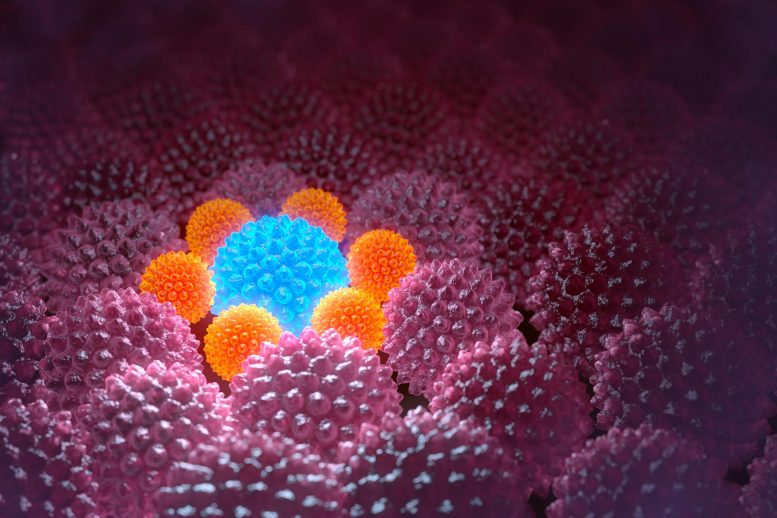
Synthetic Molecules that Adhere Cells Could Galvanize Regenerative Medicine
Scientists at the University of California, San Francisco (UCSF) have engineered molecules that act like “cellular glue,” allowing them to direct in precise fashion how cells bond with each other. The discovery represents a major step toward building tissues and organs, a long-sought goal of regenerative medicine.
Adhesive molecules are found naturally throughout the body, holding its tens of trillions of cells together in highly organized patterns. They form structures, create neuronal circuits, and guide immune cells to their targets. Adhesion also facilitates communication between cells to keep the body functioning as a self-regulating whole.
In a new study, published in the December 12, 2022, issue of Nature, researchers engineered cells containing customized adhesion molecules that bound with specific partner cells in predictable ways to form complex multicellular ensembles.
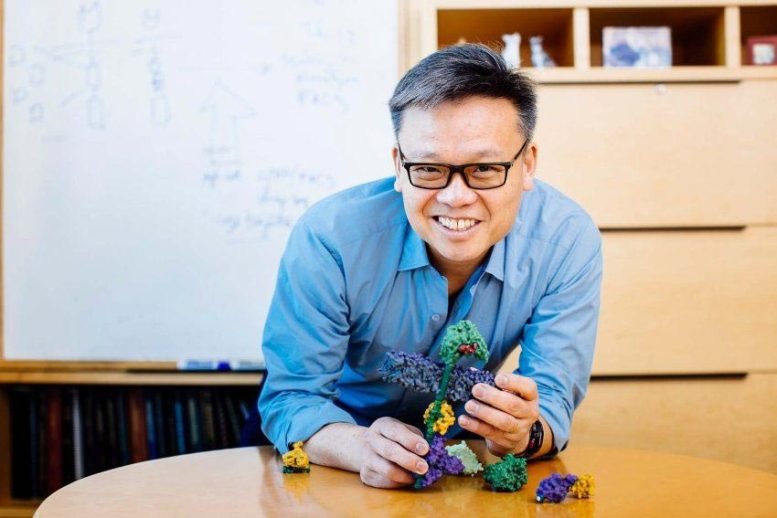
“We were able to engineer cells in a manner that allows us to control which cells they interact with, and also to control the nature of that interaction,“ said senior author Wendell Lim, PhD, the Byers Distinguished Professor of Cellular and Molecular Pharmacology and director of UCSF’s Cell Design Institute. “This opens the door to building novel structures like tissues and organs.”
Regenerating Connections Between Cells
Bodily tissues and organs begin to form in utero and continue developing through childhood. By adulthood, many of the molecular instructions that guide these generative processes have disappeared, and some tissues, like nerves, cannot heal from injury or disease.
Lim hopes to overcome this by engineering adult cells to make new connections. But doing this requires an ability to precisely engineer how cells interact with one another.
“The properties of a tissue, like your skin for example, are determined in large part by how the different cells are organized within it,” said Adam Stevens, PhD, the Hartz Fellow in the Cell Design Institute and the first author of the paper. “We’re devising ways to control this organization of cells, which is central to being able to synthesize tissues with the properties we want them to have.”
Much of what makes a given tissue distinct is how tightly its cells are bonded together. In a solid organ, like a lung or a liver, many of the cells will be bonded quite tightly. But in the immune system, weaker bonds enable the cells to flow through blood vessels or crawl between the tightly bound cells of skin or organ tissues to reach a pathogen or a wound.
“We’re devising ways to control this organization of cells, which is central to being able to synthesize tissues with the properties we want them to have.” Adams Stevens, PhD
To direct that quality of cell bonding, the researchers designed their adhesion molecules in two parts. One part of the molecule acts as a receptor on the outside of the cell and determines which other cells it will interact with. A second part, inside the cell, tunes the strength of the bond that forms. The two parts can be mixed and matched in a modular fashion, creating an array of customized cells that bond in different ways across the spectrum of cell types.
The Code Underlying Cellular Assembly
Stevens said these discoveries also have other applications. For example, researchers could design tissues to model disease states, to make it easier to study them in human tissue.
Cell adhesion was a key development in the evolution of animals and other multicellular organisms, and custom adhesion molecules may offer a deeper understanding of how the path from single to multicellular organisms began.
“It’s very exciting that we now understand much more about how evolution may have started building bodies,” he said. “Our work reveals a flexible molecular adhesion code that determines which cells will interact, and in what way. Now that we are starting to understand it, we can harness this code to direct how cells assemble into tissues and organs. These tools could be really transformative.”
Reference: “Programming Multicellular Assembly with Synthetic Cell Adhesion Molecules” by Adam J. Stevens, Andrew R. Harris, Josiah Gerdts, Ki H. Kim, Coralie Trentesaux, Jonathan T. Ramirez, Wesley L. McKeithan, Faranak Fattahi, Ophir D. Klein, Daniel A. Fletcher and Wendell A. Lim, 12 December 2022, Nature.
DOI: 10.1038/s41586-022-05622-z
Authors: Other authors include Josiah Gerdts, Ki Kim, and Wesley McKeithan of the UCSF Cell Design Institute and the Department of Cellular and Molecular Pharmacology, Jonathan Ramirez and Faranak Fattahi of the Eli and Edythe Broad Center of Regeneration Medicine and Stem Cell Research and the Dept. of Cellular and Molecular Pharmacology, Coralie Tentesaux and Ophir Klein of the UCSF Program in Craniofacial Biology and Department of Orofacial Sciences, and Andrew Harris and Dan Fletcher, of UC Berkeley Dept. of Bioengineering.
Funding: This work was supported by NSF grant DBI-1548297, NIH grant U01CA265697, and a Damon Runyon Cancer Research Foundation postdoctoral fellowship (DRG-#2355-19).
Never miss a breakthrough: Join the SciTechDaily newsletter.
Follow us on Google and Google News.
21 Comments
Can it repair spinal cord injuries can cure deseases such as paralysis and paraspinal muyo-clonis without aggravating a residual?
Could this help with auto immune issues? I have psa and my psoriasis for unknown reasons has flared up to covering most of my body. I’ve had this condition for twenty four years. I’m open to any volunteer treatment opportunities.
Actually the way that this molecular project would work better since I am a master of the periodic table, and to prove myself let me tell you something since the early 1990s I’m the only doctor in the world that created a periodic table sensor device that enabled me to create sensors that could have stopped all the mass shootings which has been suppressed by the government officials because of the embarrassment huge embarrassment they would be facing making them responsible for men women and children in schools from dying the way from dying the way they have, but when 9/11 happened I decided to try the same sensors on diseases why did that was because of that moron sending anthrax through the mail unfortunately the post office figured out how to radiate the mail but that’s dealing with the bacteria but I tried the same sensors on bacteria viruses and cancer and it worked 100%, the reason of My success is like I’ve always said the person who Masters the periodic table every element on that table is Master’s not just of the world but the universe so here’s the answer for your professors working with this amazing way of making molecules stick, you have to know exactly what percentages of elements those molecules are in order to raise their efficiency because the information you talk about in your article about losing information as we age has to do with apoptosis the tilomers on the end of the Caps of our DNA drop off which is a fancy way of saying that domino effect chemical reactions that keep Us alive on that DNA strand is important in order for us to live as long as life as we’re genetically capable of, so turn your attention to some kind of device like the ones I have that gives you the percentages how many elements anything is made of in this case human cells neurosynopsis nerve cells and so on and so forth and you cannot go wrong if you want to contact me you’re welcome to I’ll be happy to help you or guide you in that direction.
Hi I’m wondering if your device would be able to help someone that is a quadriplegic ?
A lot of autoimmune conditions are lately been discovered to be caused by unhealthy gut biomes.
Will the work of adhesion cell include that of developing cartilage? If cell adhesion could address non blood flow tissue, such as cartilage; many people could have knee repair. It would save millions of dollars in surgery costs and rehabilitation costs. If there is ever a trial for this, I would be open to it.
Who created our original body and why would we want to redesign it?
Are we keeping a balance with our mind and soul as well? Reality is unity through diversity. Are we like minded. All for one/one for all? May God rule his creation through Christ consciousness.
Thank you for your work.
Will this help with Motor Neuro Disease.
This technology is definitely not cut out for the claims in this article. It takes pre-existing cell adhesion molecule domains, and sticks on antibody-antigen interactions to act as a “glue”… Will the CAM domains mess with endogenous cell signaling? Will the antibody domains make cells a target for inflammatory response? There’s so much overstating, and while the applications are obvious, it’s no where near ready for putting into a human.
A more synthetic “glue” was published several months before this one – not sure why this Weddell guy is getting so much press, but I’d recommend testing helixCAMs over this mix&match business
Full text preprint:
https://www.biorxiv.org/content/10.1101/2022.04.19.488034v1
Published in cell:
https://pubmed.ncbi.nlm.nih.gov/36055250/
It all has to do with chemicals this will only easy answer I will give mankind.
I hope my txt helps chemicals.
Could this help heal a leg ulcer?? I have had one for years, I also live in SF so any trials that involve humans?
either increase your circulation, if needed. If not, try… https://www.ncbi.nlm.nih.gov/pmc/articles/PMC7489700/
and medicinal honey as a drawing agent
So, why not make Conjoined Twins of Caenorhabditis Worms, mice and rats? Do Bad things first to get to remarkably great things. They did not make Very 1st Plane in 1 Day ! Ditto for Biology Too ! Act at Blastular or Gastrular Stage.
Could this help with labrum tears and reconnecting labradorite tissue instead of using sutures in surgery?
Can it fix diverticulitis and wrongly operate septum surgery.
Will this eventually cure emphysema
Great work,we are heading in the right direction.
just advance this tech instead. https://www.youtube.com/watch?v=XheAMrS8Q1c